
Last Updated: October 25, 2026
Quick Summary
Basketball training busy families works by making every minute count through short, focused sessions rather than long practice blocks. Consistency and intention matter more than total hours, with most families finding three to four sessions per week sustainable while building real fundamentals in ball handling, footwork, and shooting.
- The 3-weekday plus 1-weekend template totals roughly 1 hour 40 minutes per week and is the most common pattern that survives real family life.
- Ages 9-11 should train 3 sessions per week for 20-30 minutes each, focusing on fundamentals and avoiding extra volume.
- Count every basketball exposure including team practice, games, and individual sessions toward the weekly total to avoid overtraining.
- Always warm up for 3-5 minutes and cool down for 2-3 minutes, with at least one full rest day per week.
- Track visible progress like shots made or drills completed to keep children motivated and engaged in practice.
Table of Contents
- Why Basketball Training for Busy Families Works Differently
- Basketball Drills for Kids at Home That Build Real Skills
- Building a Youth Basketball Practice Schedule That Actually Fits
- How Often Should Kids Train Basketball: Finding Your Family’s Rhythm
- Basketball Training Without a Coach: What Parents Can Do
- Keeping Kids Motivated When Time Is Tight
- Start Your Family’s Basketball Development Plan
- Frequently Asked Questions
Why Basketball Training for Busy Families Works Differently
Basketball training busy families isn’t about squeezing more hours into the week, it’s about making every minute count.
Most families assume they need court time, a coach, and structured team practice to develop real skills. But small, focused sessions build fundamentals just as effectively as long practice blocks.
This guide covers five strategies for families with limited time: building a practice schedule that fits your reality, choosing drills that deliver results, and keeping kids motivated without burning yourself out.
Basketball Drills for Kids at Home That Build Real Skills
The best basketball drills for kids at home focus on the fundamentals that matter most: ball handling, footwork, and shooting mechanics.
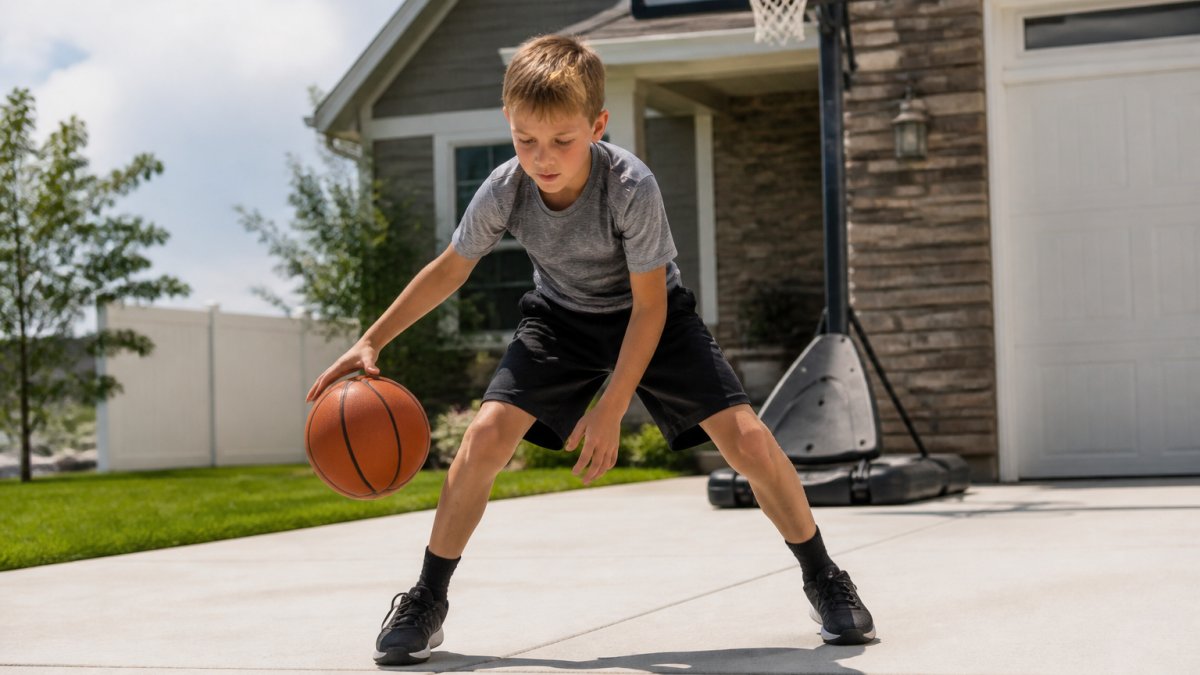
Start with drills that take 10-15 minutes and build from there.
Essential drills to start with:
- Ball-handling figure-8 dribbles around the legs
- Stationary shooting from different spots on the court
- Footwork drills like the triple threat stance and pivot moves
The mistake most parents make is choosing drills that look impressive instead of drills that build real skills.
If you’re looking for structured, game-like drills designed by professional coaches, basketball drills for beginners in driveway: 2026 guide provides specific exercises you can implement immediately in your own space.
Building a Youth Basketball Practice Schedule That Actually Fits
A youth basketball practice schedule for basketball training busy families needs flexibility built in, but flexibility without a framework is chaos. Start with a repeatable weekly template, then adjust around school, work, siblings, and activities. Most families find three to four short sessions per week sustainable long-term; more and something gives, less and progress stalls.
The 3-Weekday + 1-Weekend Template
This is the most common pattern that survives real family life:
- Monday (20 min): Ball handling and footwork before dinner
- Wednesday (20 min): Shooting mechanics in the driveway or park
- Friday (15 min): Defense and passing games
That totals roughly 1 hour 40 minutes per week, enough to build fundamentals without overwhelming anyone. Weekday sessions fit before school, after dinner, or between activities; the weekend session leaves room for variety and a sense of accomplishment.
How to Coordinate Around School, Work, Siblings, and Activities
A schedule only works if it survives the rest of your family’s life. Use these coordination tactics:
- Anchor to existing routines. Attach practice to something that already happens, after Saturday breakfast, or right after school before homework. New habits stick best when they piggyback on old ones.
- Use a shared family calendar. Put practice blocks on the same calendar as school events, work meetings, and siblings’ activities. If it’s not on the calendar, it won’t happen.
- Stagger sibling sessions. With two kids training, run one 15-minute session while the other does homework, then swap. Or have an older sibling count reps for a younger one, it builds leadership and keeps both engaged.
Age-Specific Session Lengths and Focus
What works for a 7-year-old will frustrate a 13-year-old. Use these guidelines:
- Ages 6-8: 15-20 minutes, 2-3 times per week. Focus on fun, ball familiarity, and basic footwork. Expect short attention spans, end on a high note before boredom hits.
- Ages 9-11: 20-30 minutes, 3 times per week. Introduce shooting form, simple dribble moves, and defensive stance. Repetition matters more than variety.
- Ages 12-14: 30-40 minutes, 3-4 times per week. Add game-like drills, passing under pressure, and position-specific footwork. Begin tracking progress with simple metrics (e.g., free throws made out of 10).
A Sample 20-Minute Weekday Session
Here’s what a focused 20-minute session looks like when time is tight:
- Warm-up (3 min): Dynamic stretches, light dribbling, and jumping jacks
- Ball handling (5 min): Figure-8 dribbles, crossover touches, and one-hand control drills
- Shooting (7 min): Form shooting close to the basket, then move to five spots
This structure works because it’s predictable, your child knows what’s coming, and you don’t plan from scratch each time.
Print the weekly template and put it on the fridge. A visible schedule reduces negotiation and makes practice feel like part of the routine rather than an interruption.
The real advantage of a structured plan is that it removes decision-making from the moment: you know what day you’re training and roughly what you’ll work on. That consistency, not intensity, builds skills over weeks and months.
Here’s how the most sustainable weekly template breaks down across weekdays and weekends.
| Day | Duration | Focus Area |
|---|---|---|
| Monday | 20 min | Ball handling and footwork |
| Wednesday | 20 min | Shooting mechanics |
| Friday | 15 min | Defense and passing games |
| Saturday | 45-60 min | Game-like drills and competition |
How Often Should Kids Train Basketball: Finding Your Family’s Rhythm
How often should kids train basketball depends on age, skill level, and other athletic commitments. There’s no universal answer, but there are clear guidelines that work, and clear warning signs that you’re doing too much.
Age-Based Frequency Guidelines
- Ages 6-8: 2-3 sessions per week, 15-20 minutes each. At this age, free play and general movement matter more than structured training. One or two sessions can be informal, dribbling in the driveway or shooting hoops with a parent.
- Ages 9-11: 3 sessions per week, 20-30 minutes each. This is where repetition starts to pay off. Keep sessions focused on fundamentals and avoid adding extra volume just because your child seems eager.
- Ages 12-14: 3-4 sessions per week, 30-40 minutes each. If your child is on a school or club team, team practices count toward this total. Two team practices plus one or two short individual sessions is usually plenty.
The Team Practice Multiplier
One of the most common mistakes busy families make is treating individual training as separate from team practice. It’s not. Two team practices and a game already equal three basketball exposures, adding three more individual sessions can push a young athlete into overtraining.
A simple rule: count every basketball exposure, team practice, games, PE class, and individual sessions, toward the weekly total. For most kids ages 9-14, 4-5 total exposures per week is a sensible ceiling during the school year.
Safe Training Loads: Warm-Ups, Recovery, and Rest
Rest is part of the training plan, not a break from it, young bodies adapt during recovery, not during the session. Build these habits into your routine:
- Always warm up for 3-5 minutes. Dynamic movements, leg swings, arm circles, light jogging, and dribbling, raise heart rate and prepare joints. Cold muscles and joints are more vulnerable to strains.
- Cool down and stretch for 2-3 minutes. Focus on calves, hamstrings, quads, and shoulders, especially after shooting sessions, which repeatedly load the knees and shoulders.
- Schedule at least one full rest day per week. No structured basketball. Free play is fine, but give the body a break from repetitive loading.
- Prioritize sleep and nutrition. Most youth athletes need 8-10 hours of sleep (Sleep and the Young Athlete). A snack with protein and carbohydrates within an hour after practice supports recovery.
Signs of Overtraining Parents Should Watch For
Kids often don’t recognize when they’re doing too much. Watch for these signals and back off if you see them:
- Persistent soreness that doesn’t improve with rest
- Declining performance, missing shots or losing footspeed they previously had
- Irritability, mood swings, or loss of enthusiasm for basketball
- Trouble sleeping or unusual fatigue during the day
Overuse injuries in young athletes, particularly to the knees and shoulders, are increasingly common in kids who specialize early and train year-round (Sports Specialization in Young Athletes: Evidence-Based Recommendations). If your child complains of the same pain for more than a few days, reduce training and consult a healthcare professional.
Finding Your Family’s Rhythm
The sweet spot is consistent, purposeful work that fits your family’s life, not maximum volume. A child who trains three focused times per week for a year will outperform one who trains five times per week for two months and burns out. Start at the lower end of the age-based range and adjust upward only if your child is recovering well and still enjoying it.
Frequency is a tool, not a badge of honor. The right number of sessions is the one your family can sustain consistently while keeping your child healthy, motivated, and improving.
Basketball Training Without a Coach: What Parents Can Do
Basketball training without a coach is absolutely possible.
Here’s what you can do effectively:
- Set up simple drills and count repetitions
- Provide feedback on form and technique
- Film short videos to show your child their progress
- Create friendly competitions to make practice fun
Your biggest advantage as a parent is consistency and personal investment, you can train your child more frequently than a coach can, and your involvement motivates them.
You don’t need to understand every nuance of basketball to help. Focus on the fundamentals: proper shooting form, footwork, ball control, and defensive positioning.
If you’re uncertain about technique or want professional-level guidance, structured programs designed by experienced coaches can fill that gap.
Keeping Kids Motivated When Time Is Tight
Motivation is where most busy families struggle. Learn specific strategies to keep children engaged in sports.
The key is making practice feel less like an obligation and more like something they choose, not abandoning structure, but building structure that feels rewarding.
Motivation strategies that actually work:
- Track visible progress: keep a simple record of shots made, dribbling times, or drills completed
- Create friendly competitions with siblings or friends
- Celebrate effort, not just results
- Let your child choose which drill to work on sometimes
The biggest motivation killer is boredom.
Gamified training platforms can help here. They add elements like achievements, streaks, and friendly competitions that keep kids engaged.
Start Your Family’s Basketball Development Plan
The path forward is clear: choose a realistic training schedule, focus on fundamentals, and build consistency into your family’s routine.
Your family’s basketball development doesn’t require expensive coaching or fancy facilities. Explore beginner training programs to get started with structured guidance.
Blue5 Basketball offers structured, professional-level guidance that fits into busy schedules.
The families who see real improvement aren’t the ones with the most time.
Frequently Asked Questions
How often should kids train basketball if they’re already on a team?
Most young players benefit from 3-4 training sessions per week, including team practice. Individual skill work 2-3 times weekly, even 20-30 minutes, builds fundamentals faster than team practice alone. The key is spacing sessions to allow recovery. If your child plays in-season, one focused at-home session between team practices prevents overtraining while maintaining momentum.
Can basketball training without a coach really improve my child’s skills?
Yes, structured individual practice develops ball-handling, footwork, and shooting mechanics. The difference is focus: parents guide progression rather than design it. Use age-appropriate drills that isolate one skill at a time, track progress through simple metrics (free throws made, dribble speed), and keep sessions short and purposeful. Combining this with occasional coaching feedback accelerates results.
What’s the minimum time needed for basketball drills for kids at home?
Twenty to thirty minutes of focused work produces real improvement. Warm-up (5 min), one primary drill (15-20 min), and cool-down (5 min) is enough. Consistency matters more than length, three 25-minute sessions weekly outperform one 90-minute session. Short, frequent practice builds muscle memory and keeps kids engaged without burning them out.
How do I create a youth basketball practice schedule around school and other activities?
Start by identifying two fixed training windows each week, perhaps Tuesday and Thursday evenings, or Saturday morning. Block 30-45 minutes, not longer. Pair team practice with one at-home session in the same week to reinforce skills. Use lighter sessions during heavy school weeks and slightly longer ones during lighter periods. This rhythm prevents scheduling conflicts and keeps training sustainable year-round.
Basketball training for busy families works because it meets you where you are. You don’t need perfect conditions or unlimited time to help your child develop real skills. You need consistency, clarity, and a willingness to show up. That’s something every family can do.
