
Table of Contents
- Driveway Basketball Drills for Beginners: Start Here
- Beginner Basketball Dribbling Drills to Build Control
- Basketball Drills You Can Do Alone in the Driveway
- Driveway Basketball Shooting Drills for Accuracy
- Basketball Drills for Kids at Home: Footwork and Balance
- Build a Complete Beginner Practice Plan
- Track Progress and Avoid Common Mistakes
- Conclusion
- Frequently Asked Questions
Last Updated: October 19, 2026
Driveway Basketball Drills for Beginners: Start Here
Basketball drills for beginners in driveway settings work best when you start with a simple setup and a short, repeatable session. A driveway gives you just enough space to build real fundamentals, and you don’t need a full court to see progress.
Here’s the good news: most young players improve fastest with 20 to 30 focused minutes, three or four times a week. Consistency beats long sessions every time. This guide from Blue5 Basketball walks you through the exact drills to run, in the right order, so a beginner can train at home without guessing.
What You’ll Need Before Your First Session
Keep the gear list short and cheap. You need a ball, a hoop, and a few markers.
- A properly inflated basketball (youth size for younger kids)
- A hoop or portable backboard, adjusted to a reachable height
- 4 to 6 cones, or chalk marks, or water bottles
- Sneakers with good grip
- A clear, dry stretch of driveway
Check the surface first. Sweep away gravel and check for cracks. Move cars and bikes out of the way. A safe space matters more than a fancy one.
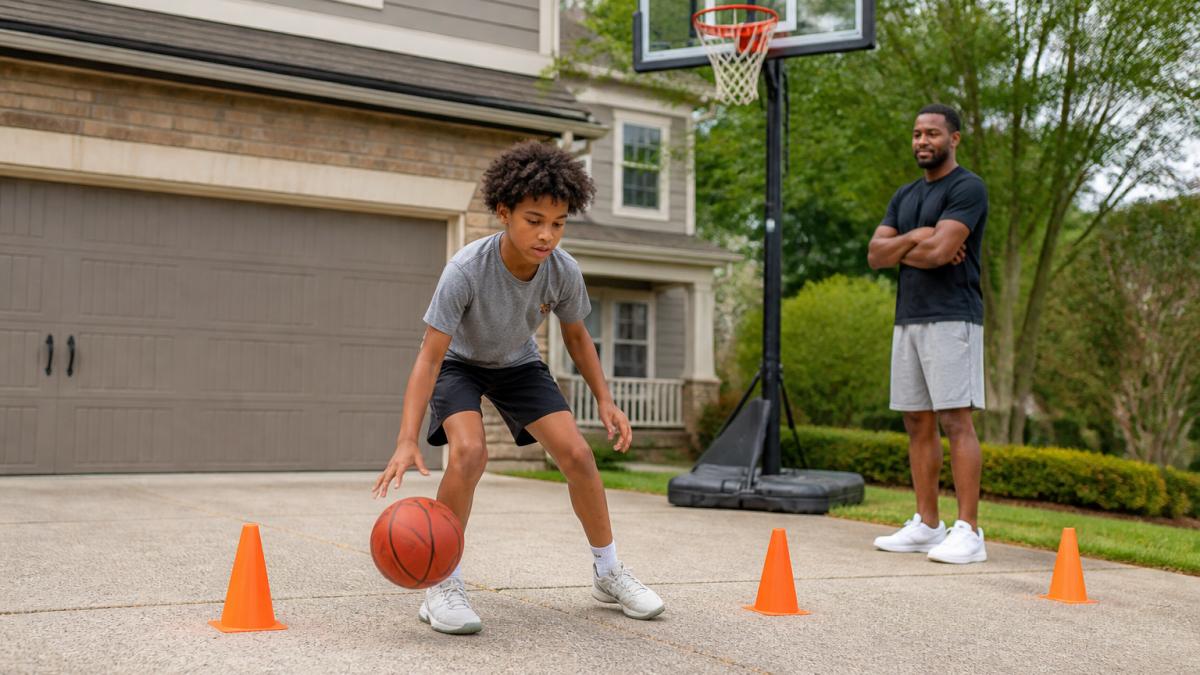
Beginner Basketball Dribbling Drills to Build Control
Control comes before speed. Every beginner basketball dribbling drill below starts slow on purpose. If a player can’t dribble without looking down, they aren’t ready to go faster.
Stationary Dribble Series
Stand still and dribble with purpose. Run each move for 30 seconds, then switch hands.
- Waist-high dribble: Dribble at hip height with firm fingertips, not the palm.
- Low dribble: Keep the ball below the knee for quick control.
- Ball wraps: Pass the ball around your waist, then your legs, without dribbling.
- Dribble tap: Alternate hands in front of your body, tapping the ball side to side.
Coaching cue: keep your head up and your eyes forward. A common mistake is slapping the ball with a flat hand. Use your fingertips instead.
Crossover and Figure Eight
The crossover teaches change of direction. The figure eight builds hand-eye coordination between both hands.
- Crossover: Dribble right, push the ball low across to your left hand, then repeat.
- Figure eight: Weave the ball around and between your legs in a figure-eight path while standing still.
Start slow. Speed comes later. Most beginners rush this and lose the ball. Slow reps build the weak hand faster than fast, sloppy ones.
Have the player say “switch” out loud on every crossover. It forces them to think about the change of direction instead of zoning out during reps.
Basketball Drills You Can Do Alone in the Driveway
Solo practice is where beginners make the biggest jump, but a driveway imposes real constraints: limited width, a single hoop, no rebounder, and sometimes no usable wall. The drills below are chosen because they work inside those limits, and each one includes a setup, a coaching cue, and a simple way to make it harder without adding equipment.
Wall Passes (If You Have a Safe Wall)
Find a flat, clear section of wall, garage doors and brick can scuff the ball, so a smooth exterior wall or a portable backboard works best. Stand 6 to 8 feet back.
- Chest pass against the wall, catch with soft hands, 20 reps.
- One-hand push pass with each hand, 15 reps per side.
- Overhead pass, 10 reps.
Coaching cue: step into the pass and finish with thumbs down. A common mistake is catching with stiff, flat palms, give with the ball slightly on contact.
If no safe wall exists, substitute a partner-free “ball slap” drill: hold the ball overhead and slap it into the ground with two hands, catching it on the rebound at waist height, 20 reps.
Self-Toss Layups
Stand one step outside the lane at a 45-degree angle. Toss the ball up off the backboard, take one dribble, and finish with the correct foot (right hand = right foot). Do 10 on each side.
Coaching cue: aim for the top corner of the square. A common mistake is jumping off the wrong foot, slow the approach until the two-step rhythm is automatic.
Progression: start with no dribble (catch-and-finish), then add one dribble, then two.
Dribble Moves on the Move
Walk the length of the driveway doing a different move each pass: crossover, between-the-legs, behind-the-back, and retreat dribble. Keep your eyes up and use the full width of the driveway, not just a straight line.
Coaching cue: change pace, not just direction. A common mistake is dribbling at one speed, practice slow-to-fast transitions.
Free Throw Reps Without a Rebounder
Shoot 10 free throws, chase your own rebounds, and record makes out of 10. To simulate pressure, require two makes in a row before you can stop; if you miss, the count resets.
Coaching cue: same routine every time, dribble twice, spin the ball, breathe, shoot. A common mistake is rushing the second shot after a miss.
No-Equipment and Narrow-Driveway Adaptations
- No cones: use chalk marks, water bottles, or shoes as markers.
- Narrow driveway: replace the cone weave with stationary dribble moves and short lateral slides.
- No regulation hoop: form shooting at a portable hoop set to a reachable height still builds release and arc.
- Limited balls: one ball is enough, rotate through the drills above in order.
A simple rule: pick two drills per solo session and do them well. Ten focused minutes of ball handling beats an hour of aimless bouncing.
Driveway Basketball Shooting Drills for Accuracy
Accuracy starts close to the rim. Driveway basketball shooting drills should begin a few feet from the hoop, not at the three-point line. Beginners who shoot from deep too early build bad habits that take months to fix.
Form Shooting and Free Throws
Form shooting is the foundation. Stand close to the hoop and shoot with one hand, focusing on a smooth release and a high arc.
- Start two steps from the rim.
- Shoot 10 one-handed shots with a soft flick of the wrist.
- Move back one step and repeat.
- Finish with 10 free throws.
Track makes out of 10 each session. The number will climb slowly, and that’s normal. Repetition with good form beats volume with bad form.
Don’t let a beginner shoot three-pointers before they can make consistent free throws. Deep shooting with weak form teaches the body to heave the ball, and that habit is hard to undo.
Basketball Drills for Kids at Home: Footwork and Balance
Footwork and balance turn a dribbler into a player. These basketball drills for kids at home focus on stopping, starting, and changing direction safely. Good balance also lowers the risk of rolled ankles on a hard driveway surface.
- Jump stop: Jump off one foot and land on two, knees bent. Do 10 reps.
- Layup steps: Practice the two-step rhythm without the ball, then add it.
- Cone weave: Set cones in a line and weave through them at a jog.
- Balance holds: Stand on one foot for 20 seconds, then switch.
Coaching cue: stay low and keep your chest up. Players who stand tall lose balance and control. A common mistake is landing flat-footed on the jump stop. Land soft, on the balls of your feet.
Build a Complete Beginner Practice Plan
A beginner practice plan should take about 25 minutes and follow the same order every time. Structure removes the guesswork and keeps young players focused.
| Phase | Time | What to Do |
|---|---|---|
| Warm-up | 5 min | Jog, arm circles, light dribbling |
| Ball handling | 7 min | Stationary series, crossover, figure eight |
| Shooting | 7 min | Form shooting, free throws |
| Footwork | 4 min | Jump stops, layup steps, cone weave |
| Cool-down | 2 min | Stretch and review |
Run this three or four days a week. As skills improve, add reps or a new drill instead of more time. This is how age- and ability-based progression works in practice: same plan, harder reps.
At Blue5 Basketball, our app turns a plan like this into structured weekly workouts that build on each other. Players get achievements and streaks to stay motivated, and families can track progress without hiring a private coach.
The best driveway routine is the one a player repeats. A simple 25-minute plan done four times a week beats a long, complicated session done once.
Track Progress and Avoid Common Mistakes
Progress tracking keeps beginners motivated, but most drill lists never tell you what to measure. Use three simple benchmarks, recorded once a week in a notebook or phone note:
- Controlled dribbles: Count consecutive dribbles with each hand without losing control or looking down. A beginner might start at 10; a realistic goal is 30 per hand within a month.
- Set-spot makes: Shoot 10 form shots from two steps in front of the rim and 10 free throws. Record makes out of 10 for each.
- Cone-weave time: Time a there-and-back weave through 4 to 6 markers. Track the time and the number of times you lose control.
A common pattern is fast early gains in dribbling and slower gains in shooting, that is normal. If a number stalls for two weeks, change one variable (distance, hand, or speed), not the whole plan.
Common Beginner Mistakes and Fixes
- Dominant-hand only: Force the weak hand to start every drill for one week. Most beginners avoid it because it feels awkward, which is exactly why it improves fastest.
- Shooting from too far out: Stay within two steps of the rim until form shooting makes 8 out of 10. Deep shots with weak form teach the body to heave the ball.
- Skipping the warm-up on a cold driveway: A cold surface and cold muscles raise ankle-roll risk. Five minutes of jogging, arm circles, and light dribbling is enough.
- One long weekly session: Two hours once a week beats nothing, but 25 minutes three or four times a week builds skill faster because repetition spacing matters.
- Dribbling while staring at the ball: Have the player call out a number you hold up, or dribble with eyes on a fixed point at rim height.
- Landing flat-footed on jump stops: Land soft on the balls of your feet with knees bent; this also protects ankles on hard pavement.
Fix these early and skill development speeds up. For more on safe youth training habits, see health and safety guidance for youth sports.
Conclusion
The hardest part of driveway training isn’t the drills. It’s keeping a young player interested week after week when the same reps start to feel boring. That’s where a structured, gamified system helps.
Blue5 Basketball was created by former Duke assistant coach and NBA lottery pick Will Avery to make professional-level training affordable and flexible. Players train anywhere, including the driveway, while earning badges, streaks, and friendly competition through friend codes. If you want a clear path instead of guesswork, start your free 7-day trial and give your player a plan that grows with them.
Frequently Asked Questions
What basketball drills can you do alone in a driveway?
You can practice stationary dribbling, crossover and figure-eight dribbles, form shooting, free throws, and cone-based footwork drills without a partner. These basketball drills you can do alone focus on repetition and control, making them ideal for driveway basketball. Set up cones or markers for change-of-direction work and use a rebounding routine to keep sessions efficient. Even 20 minutes of focused solo practice builds hand-eye coordination and confidence.
How long should a beginner basketball practice session be?
Beginners should aim for 30 to 45 minutes per session, three to four times per week. Break the time into a 5-minute warm-up, 15-20 minutes of skill work like dribbling and shooting, and 10 minutes of footwork or balance drills. Shorter, consistent sessions beat long occasional workouts for skill development. Young players can start with 20-minute sessions and add time as their focus improves.
What are some good basketball drills for a 12-year-old?
Twelve-year-olds benefit from dribble tap series, crossover drills, form shooting close to the hoop, and jump-stop layups. Add cone drills for change of direction and balance work like single-leg holds. Keep reps controlled rather than fast, and track made shots or successful dribbles to measure progress. These basketball drills for kids at home build the fundamentals that translate to team play.