
Table of Contents
- What Professional Basketball Coaching Actually Means
- The Real Benefits of Professional Basketball Coaching
- Private Basketball Lessons Cost: Breaking Down the Investment
- How Often Should a Basketball Player Train for Real Results
- Choosing a Youth Basketball Coach: What Actually Matters
- Basketball Skills Training Apps: A Practical Alternative
- Is Coaching Worth It for Your Player? A Decision Framework
- Frequently Asked Questions
Last Updated: October 18, 2026
What Professional Basketball Coaching Actually Means
Professional basketball coaching is structured, one-on-one or small-group instruction delivered by someone with formal training, competitive experience, or both. It’s not pickup games or casual advice from a friend who played in high school. It’s deliberate skill development guided by someone who understands basketball mechanics, player psychology, and how to translate court fundamentals into measurable improvement.
The term covers private lessons, small-group clinics, AAU team coaching, and digital platforms. What ties them together is intentionality: a professional coach diagnoses weaknesses, designs drills to address them, and tracks progress.
The gap between casual play and structured training is enormous. A player shooting hoops for an hour might take 50 shots. A coached session might involve 50 shots with mechanics cues, video feedback, and corrective adjustments after every 10 attempts. Same time investment, completely different outcomes.
The Real Benefits of Professional Basketball Coaching
The case for coaching rests on three concrete advantages: accelerated skill development, personalized feedback, and structured progression.
Accelerated learning curves. Without coaching, players develop habits, good and bad, through repetition alone. A player might shoot thousands of jump shots with poor footwork and never realize it. A coach identifies the problem in minutes, so instead of spending two years figuring out why your three-point shot is inconsistent, you fix the release point in a few weeks.
Personalized feedback. A coach watches your footwork, release, and decision-making in game situations, things you can’t see about yourself, and adapts instruction to your learning style, strengths, and weaknesses.
Structured progression. Coaching provides a plan that builds systematically: week one on fundamentals, week four adding game-speed drills, week eight introducing competitive scenarios. Without structure, players repeat the same drills or jump between random skills without a foundation.
The question isn’t whether coaching works, it does. The real question is whether the cost and time commitment make sense for your specific player and goals.
Private Basketball Lessons Cost: Breaking Down the Investment
Private basketball lessons vary widely in cost by coach experience, location, and format. Rather than quote a single national number, understand the pricing tiers most families encounter.
Pricing tiers you’ll see in most markets. A local high school or club coach running small-group sessions sits at the low end.
Because rates shift by city and coach reputation, ask for a per-session rate, a package rate, and a cancellation policy before committing.
The full investment is more than the fee. Add up four costs before deciding:
- Coaching fees, per session or package.
- Travel time, a twice-weekly session 30 minutes away is two hours of driving per week.
- Opportunity cost, those hours aren’t available for homework, other sports, or rest.
- Equipment and recovery, shoes, gear, and occasional physio visits add up over a season.
A cost-benefit framework you can actually use. The question isn’t “is coaching expensive?” but “is this the best use of the next dollar and hour?”
- What is the specific, measurable goal? “Make the varsity roster,” “raise free-throw percentage from 60% to 75%,” or “earn a college look” are goals you can evaluate. “Get better” is not.
- What is the baseline? Record current numbers, shooting percentages, turnover rate, vertical, sprint times, before the first session. Without a baseline you cannot tell whether the fee bought improvement.
- What is the realistic ceiling? A beginner with multiple fundamental gaps has more room to improve per session than an advanced player polishing one skill.
- What is the next-best alternative? Compare the coaching fee against an AAU season, a skills app subscription, a camp, or structured solo practice. Which produces the most improvement per dollar and per hour for this player?
Coaching pays for itself when it produces measurable improvement against a baseline you recorded before you started. If you cannot point to a specific number that moved after 8-12 weeks, the fee did not buy development, regardless of how good the sessions felt.
When the math favors alternatives. Coaching is usually the weaker investment when the player is already fundamentally sound, motivation is low, the schedule is sporadic, or a strong AAU program and peer training already provide structure and feedback.
A blended plan often wins on value. Many families get the best return by combining one private session per week with app-guided solo work, team practice, and pickup games.
At Blue5 Basketball, we’ve worked with families across this spectrum. Some invest in private coaching because their player is serious about a competitive goal.
How Often Should a Basketball Player Train for Real Results
Frequency matters more than most parents realize, but frequency without measurement is just activity. The useful question isn’t only “how often?” but “how often, measured how, against what baseline, on what timeline?”
Start with a baseline. Before the first paid session, record objective numbers for the skills you care about:
- Shooting: free-throw percentage out of 50 attempts, three-point percentage out of 25 attempts from each wing and the top of the key, and mid-range percentage off the dribble.
- Ball handling: timed cone drills with a turnover count, or a set number of crossover and retreat-dribble repetitions against a defender.
- Footwork and defense: lateral slide times, closeout repetitions, and a coach’s simple rating of stance and balance.
- Conditioning: a timed sprint or shuttle run.
Write the numbers down. A baseline is what turns “I think I’m getting better” into “my free-throw percentage moved from 62% to 78% in ten weeks.”
Frequency guidance by goal. Most practitioners find these patterns hold for young players:
- Once per week maintains skill and corrects form, but gains are slow. Best as a supplement to team practice.
- Twice per week is the common sweet spot for measurable improvement, enough repetition for motor patterns to stick while leaving recovery time.
- Three times per week accelerates progress, especially for players with multiple fundamental gaps, but only with recovery and practice between sessions.
- Four or more sessions per week shows diminishing returns for most young players unless they’re already competitive and have the recovery, nutrition, and sleep to support it.
The type of training counts too. Team practice, AAU games, pickup games, and one-on-one coaching all build skill when they include repetition with feedback.
Realistic timelines. Players typically see noticeable change in a specific skill after 8-12 weeks of twice-weekly, focused work. Early weeks show mechanical change before statistical change, the shot looks different before the percentage moves.
If three months pass with no measurable change against your baseline, do not simply add more sessions. Either the training is not focused on the right skill, the coach is not a good fit, or the player is not practicing between sessions. More of the same rarely fixes a stalled plan.
Consistency beats intensity. A player who trains intensely for two weeks then takes three weeks off loses ground; a player who trains consistently at a moderate level for three months gains more.
Track progress in a simple log. Keep a one-page sheet with the date, the skill worked on, the drill, and the number, and review it every four weeks with the coach.
Choosing a Youth Basketball Coach: What Actually Matters
Three factors determine whether a coach is worth your time and money: experience level, teaching ability, and player-coach fit.
Experience level doesn’t mean they played professionally, it means they understand the game deeply.
Teaching ability is separate from playing ability. A former NBA player might be a terrible teacher; a high school coach might be excellent.
Player-coach fit is underrated. Some coaches work best with confident, self-motivated players. Others excel with players who need encouragement. Some specialize in young beginners; others work with advanced athletes.
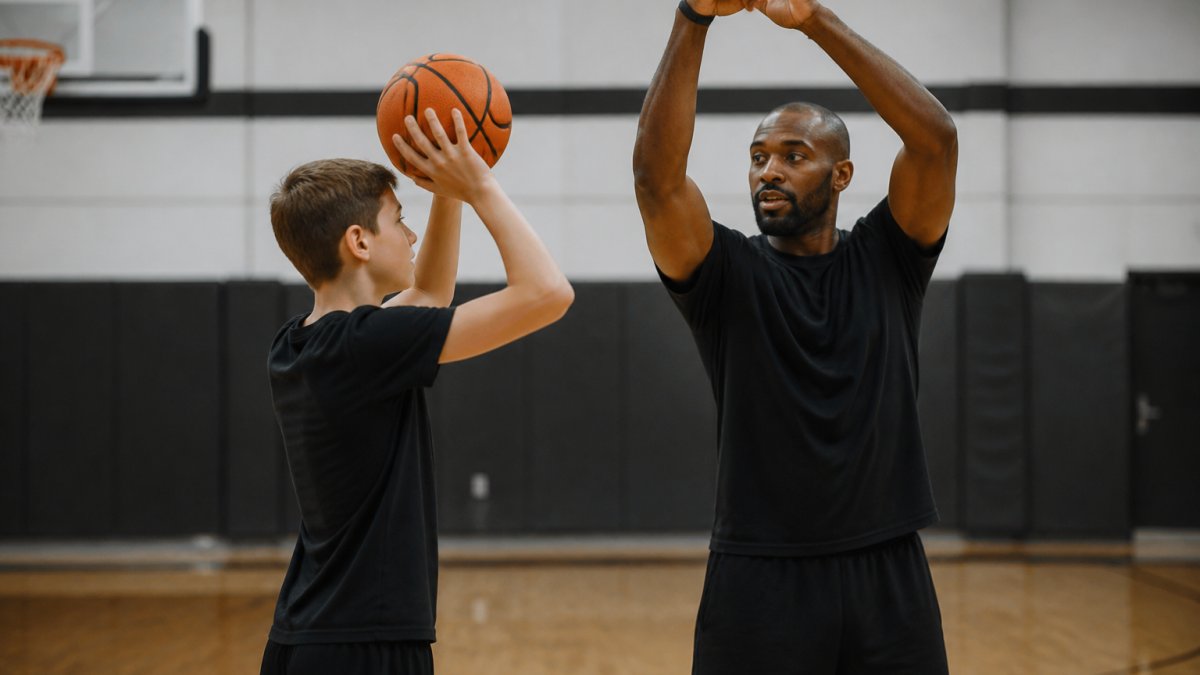
Red flags: A coach who can’t articulate why they’re making corrections. A coach who runs the same drill every session. A coach who doesn’t track progress or discuss goals.
Good signs: They ask questions about your player’s goals. They film sessions and review footage. They explain the “why” behind drills. They communicate progress and adjust the plan based on results.
Basketball Skills Training Apps: A Practical Alternative
Digital training platforms offer structure, affordability, and flexibility compared to private coaching. They can’t replace a human coach entirely, but they fill a real gap.
A skills training app works best when it provides structured workouts, tracks progress, and includes a feedback mechanism. Video analysis helps, and gamification, achievements, streaks, competitions, keeps players engaged. Training anywhere, including at home or in a driveway, removes logistical barriers.
The trade-off is obvious: an app can’t watch your footwork and correct it in real time, adjust difficulty based on how you’re performing that day, or motivate you through a tough session.
For families exploring whether coaching is worth it, an app offers a low-risk entry point: a player can test whether structured training improves their game before committing to paid coaching.
The best apps combine professional instruction with engagement mechanics that keep young players coming back. Workouts should build progressively, early sessions focus on fundamentals, later sessions add complexity and game speed. Progress tracking should be visible so players see improvement over weeks and months.
Is Coaching Worth It for Your Player? A Decision Framework
Here’s how to evaluate whether professional basketball coaching makes sense for your specific situation.
Step 1: Clarify the goal. Is your player trying to make a competitive team? Improve fundamentals for recreational play? Build confidence? Get recruited for college? The goal determines whether coaching is necessary.
Step 2: Assess current skill level. Beginners benefit from coaching more than advanced players because there’s more to fix.
Step 3: Consider alternatives. Coaching isn’t the only path to improvement. AAU teams provide structure and competition, peer training develops skills, and apps and self-directed practice work for some players.
Step 4: Test before committing. Try a few sessions or a short-term program before signing up for ongoing coaching.
Step 5: Track progress objectively. After 8-12 weeks of coaching, can you point to specific improvements? Shooting percentage up? Ball handling smoother? Faster decision-making?
| Decision Factor | Coaching Worth It | Coaching Not Worth It |
|---|---|---|
| Player goal | College recruitment, competitive team placement | Casual improvement, recreational play |
| Current skill | Multiple fundamental gaps | Already solid fundamentals |
| Motivation | High internal drive | Low interest in structured training |
| Time availability | Consistent 2+ sessions weekly possible | Sporadic, inconsistent schedule |
| Budget | Can afford without strain | Tight budget, competing priorities |
| Alternative access | Limited quality coaching options | Strong AAU program, peer training available |
At Blue5 Basketball, we’ve worked with families at every point on this spectrum. Some parents invest in private coaching because their player is serious about the sport.
Professional basketball coaching delivers real value for players with clear goals, consistent commitment, and the right coach-player fit.
Frequently Asked Questions
Is professional basketball coaching worth the cost for young players?
Professional basketball coaching delivers measurable skill development, personalized feedback, and structured progression that accelerates improvement. Whether it’s worth the cost depends on your player’s goals, current skill level, and access to alternatives. Many families find value in combining professional coaching with structured practice and skills training apps to balance cost and outcomes. The key is choosing coaching that aligns with your player’s specific needs rather than assuming all coaching delivers equal value.
Can a basketball skills training app actually improve my child’s skills?
Yes. A basketball skills training app can build fundamental skills, discipline, and consistent practice habits when designed by experienced coaches. Apps work best for players who need structure, motivation, and accessible training options. They’re particularly effective for developing footwork, shooting mechanics, and ball handling through repetition and feedback. Many players use apps alongside team practice or occasional coaching to maintain progress between sessions and train at home or in limited spaces.
How often should a basketball player train to see real improvement?
Consistent, structured training sessions, combined with regular team or independent practice, are key for measurable progress. Consistency matters more than intensity. Young players benefit from shorter, focused workouts (30-45 minutes) that build on previous sessions rather than sporadic long sessions. Training frequency should match the player’s goals: competitive AAU athletes typically train more frequently than recreational players. Rest and recovery are equally important to prevent burnout and injury.
What should I look for when choosing a youth basketball coach?
Prioritize coaches with verifiable playing or coaching experience, a clear teaching philosophy, and a track record of player development. Ask about their approach to feedback, how they assess player progress, and how they adapt to individual learning styles. Check references from current or former players and families. Ensure the coach prioritizes fundamentals, safety, and age-appropriate skill progression. A good coach-player fit matters as much as credentials: your player should feel motivated and supported, not discouraged.