
Table of Contents
- Start With the Right Basketball Dribbling Stance and Hand Position
- Basketball Dribbling Drills for Beginners: Build Your Foundation
- How to Do a Crossover Dribble (and When to Use It)
- How to Dribble Without Looking at the Ball
- A Progressive Basketball Dribbling Workout for Ages 11-18
- Common Dribbling Mistakes and How to Fix Them
- Warm-Ups, Practice Load, and Staying Injury-Free
- Conclusion
- Frequently Asked Questions
Last Updated: October 15, 2026
Start With the Right Basketball Dribbling Stance and Hand Position
Great ball handling starts before the ball ever moves. Mastering basketball dribbling begins with the body, not the hands. Get the stance right, and everything else gets easier.
Here is the core rule: your body does the work, and your fingers guide the ball.
Fingertips, Not Palms: The Ball Control Rule
Ball control comes from your fingertips and finger pads, not your palm. Your palm is a flat, dead surface.
Think of your hand as a soft claw. Keep a small gap between the ball and your palm.
This one change fixes most beginner problems. Players who slap the ball with a flat palm lose control on every bounce.
Bent Knees, Chest Up, Head Forward
A balanced position keeps you ready to move in any direction. Here is what that looks like:
- Knees bent, not locked
- Feet about shoulder-width apart
- Chest up, back straight
This low stance lets you change direction fast. It also protects the ball from defenders.
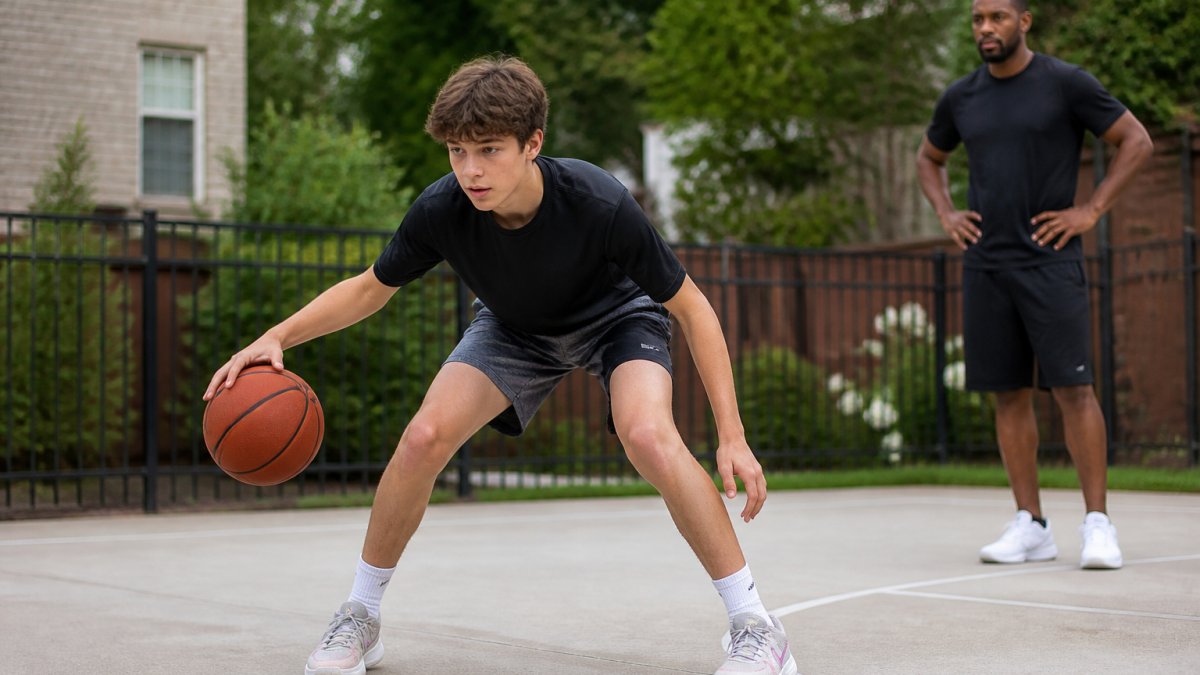
Most players bend at the waist instead of the knees. That throws off their balance and slows their first step. Bend the knees, keep the chest up, and you will feel the difference in your first move.
Basketball Dribbling Drills for Beginners: Build Your Foundation
Basketball dribbling drills for beginners should start simple and stay boring for a while. Repetition builds the muscle memory that makes everything else possible.
A common mistake is rushing to fancy moves. Skip that. Spend your first weeks on the basics below.
Stationary Ball-Handling Drills (Both Hands)
Start standing still. Practice these with each hand:
- Pound dribble – Push the ball down hard to waist height. Use your dominant hand, then your weak hand.
- Low dribble – Keep the ball below your knee. Quick, short bounces.
- Figure-eight – Weave the ball around and between your legs.
- Fingertip taps – Tap the ball back and forth between your hands, fast.
Do each drill for 30 to 60 seconds. Switch hands every round. Your weak hand needs double the work.
Moving Dribbles and Change of Pace
Once stationary feels easy, add movement. Walk, then jog, then run while you dribble.
Practice a change of pace: dribble slow, then explode into a fast burst for two steps. This is how you beat a defender without a single fancy move.
Also practice changing direction. Go left, plant, then cut right. Keep the ball low through the turn.
How to Do a Crossover Dribble (and When to Use It)
Learning how to do a crossover dribble is a milestone for young players. The move itself is simple. The skill is knowing when to use it and how to read the defender in front of you.
The Crossover Mechanics
Here is the step-by-step:
- Push the ball low and hard from one hand to the other.
- Keep the bounce below your knee, ideally around ankle height.
- Step in the direction you are going as the ball crosses.
- Catch it with your opposite hand and keep your head up.
- Keep your body between the ball and the defender after the catch.
A common pattern coaches teach: sell the fake with your eyes and shoulders first, then push the ball. If your head and shoulders do not move, the defender will not bite.
The biggest crossover mistake is bouncing the ball too high. A high crossover is slow and easy to steal. Keep it low, and keep your hand over the top of the ball so you can shield it.
How to Read a Defender Before You Cross
A crossover only works if the defender is leaning or reaching. Before you dribble, scan for these cues:
- Weight on one foot. If the defender’s weight is on their left foot, attack their right side.
- Hands reaching. A reaching defender is off balance. Cross away from the reach.
- Feet too close together. A narrow base means a slow lateral slide. Attack the open lane.
If the defender is balanced, low, and patient, do not force the crossover. Back out, reset, and use a change of pace instead. Forcing a crossover into a set defender is how turnovers happen.
When NOT to Use a Crossover
- When a second defender is nearby and ready to help.
- When you are trapped near the sideline or baseline.
- When your weak hand is not yet reliable, a sloppy crossover is a live-ball turnover.
Protecting the Ball in Live Play
Once you beat your man, the ball is not safe yet. Use these habits:
- Keep your body between the ball and the defender.
- Keep the ball low and on the far side of your body.
- Use your off arm as a legal shield, not a push-off.
A simple self-check: after every crossover in a drill, ask yourself, “Did I keep the ball below the defender’s hand?” If the answer is no, the move was too high.
Practice the crossover against a partner who is allowed to reach but not foul. This trains you to read hands and protect the ball, not just execute the move in open space.
How to Dribble Without Looking at the Ball
Learning how to dribble without looking at the ball is the skill that separates good players from great ones. It comes down to one thing: trust your fingertips and train your eyes to look up.
Most players can dribble with their eyes up in a few weeks if they train it deliberately. The key is to make it measurable instead of hoping it happens.
A Four-Week Eyes-Up Progression
Use this progression three to four days a week. Each session should take 10 to 15 minutes.
| Week | Drill | Target | Self-Check |
|---|---|---|---|
| 1 | Dribble while staring at a fixed point across the room | 30 seconds each hand, no glances down | Count glances down; aim for zero |
| 2 | Partner holds up fingers; call out the number | 20 correct calls in a row | Track misses per hand |
| 3 | Dribble while walking, then jogging, eyes up | 60 seconds continuous, both hands | Note which hand loses control first |
| 4 | Dribble with eyes up while a partner waves hands or calls directions | 90 seconds, respond to cues | Count errors per minute |
Write down your numbers each session. If your weak hand fails twice as often as your strong hand, give it double the reps.
Why Looking Down Hurts You
When your eyes drop to the ball, three things happen:
- You cannot see open teammates or cutters.
- You cannot see the defender stepping into your path.
- Your body tends to straighten up, which slows your first step.
In live play, a single glance down can cost you a pass or a turnover. That is why coaches treat eyes-up dribbling as a non-negotiable habit, not a bonus skill.
Common Errors and Fixes
| Error | What It Looks Like | The Fix |
|---|---|---|
| Glancing down under pressure | Eyes drop when a defender approaches | Practice with a partner reaching at the ball while you keep eyes up |
| Losing control with weak hand | Ball bounces away when you look up | Slow the dribble down; use fingertips, not palm |
| Standing up straight | Body rises when eyes lift | Re-check knee bend; stay low through the drill |
| Speeding up too soon | Dribble gets wild when you add movement | Master stationary eyes-up before adding walking or jogging |
How to Track Progress
Simple metrics keep this skill honest:
- Glances down per minute. Aim to reduce this number each week.
- Errors per minute. Count lost balls or double-dribbles.
- Weak-hand success rate. Compare strong-hand and weak-hand reps.
- Time under control. How long can you dribble eyes-up before a mistake?
A common pattern is that players improve fast in week one, plateau in week two, then jump again in week three. Do not quit during the plateau. That is when the habit is forming.
Eyes-up dribbling is not a talent. It is a trainable habit with measurable milestones. Track it, and it will improve.
A Progressive Basketball Dribbling Workout for Ages 11-18
A basketball dribbling workout works best when it builds over time. Random practice gets random results. A clear plan gets real improvement.
Here is a weekly structure, built on measurable milestones.
Weekly Plan: Weeks 1-4, 5-8, 9-12
| Phase | Focus | Key Drills | Milestone |
|---|---|---|---|
| Weeks 1-4 | Stationary control | Pound, low, figure-eight | 60 seconds each hand, no mistakes |
| Weeks 5-8 | Movement and pace | Walk-jog-run, change of pace | Dribble while jogging, head up |
| Weeks 9-12 | Game-like moves | Crossover, between-the-legs, behind-the-back | Beat a live defender in a drill |
Train three to four days a week. Keep each session to 20 to 30 minutes. Short and focused beats long and sloppy.
Track your progress. Time each drill and write it down. Measurable goals keep players motivated.
Common Dribbling Mistakes and How to Fix Them
Most dribbling problems trace back to a handful of habits. Fix these and your handles improve fast.
| Mistake | What It Causes | The Fix |
|---|---|---|
| Slapping with the palm | Poor ball control | Use fingertips and finger pads |
| Standing straight up | Slow first step | Bend your knees, stay low |
| Looking at the ball | Missed passes and open players | Train eyes up with partner drills |
| Dribbling too high | Easy steals | Keep the bounce below the knee |
| Using only the strong hand | Predictable play | Give the weak hand double reps |
A common mistake is practicing only your dominant hand. Defenders figure that out fast. Train both hands until they feel equal.
The players who improve fastest are not the ones with the fanciest moves. They are the ones who drill the basics with both hands, every single week.
Warm-Ups, Practice Load, and Staying Injury-Free
Skip the warm-up and you risk more than a bad session. Cold muscles and stiff joints lead to sprains and rolled ankles.
Before every workout, spend five to ten minutes on this:
- Jog in place or around the driveway
- Arm circles and shoulder rolls
- Ankle rotations, both directions
- Leg swings, front to back
Practice load matters too. Young athletes need rest days. Train three to four days, then take a day off. Sore joints are a signal to slow down, not push through.
Structured training should build discipline and confidence, not pain. If something hurts, stop and rest.
Conclusion
Building real handles takes weeks of focused, consistent work, not one big session.
Blue5 Basketball turns that work into a clear, structured path. Our app, built by former Duke assistant coach and NBA lottery pick Will Avery, gives players purposeful workouts they can do anywhere.
Start your free 7-day trial with Blue5 Basketball and give your player a plan that actually builds skills.
Frequently Asked Questions
How often should a young player practice basketball dribbling?
Aim for 15-20 minutes of focused ball-handling four to five days per week. Short, consistent sessions beat one long weekend workout. Players who practice dribbling drills for beginners daily see faster improvement in ball control and coordination than those who train once a week. Build in rest days so hands and wrists recover, and rotate between stationary drills and moving dribbles to keep sessions fresh.
How can you dribble without looking at the ball?
Start with stationary dribbles at waist height while staring at a fixed point across the room. Progress to calling out numbers a parent holds up, then dribble while walking and looking straight ahead. The key is repetition: your fingertips build a feel for the ball’s bounce so your eyes can scan the court. Practice this for five minutes each session before moving to game-like drills.
What is a crossover dribble and how do you do one?
A crossover dribble moves the ball from one hand to the other in front of your body to change direction. Push the ball low and quick across your body, keep your hand on top of the ball, and land on your opposite foot as you receive it. Keep the dribble below your knees so defenders cannot swipe it. Practice slowly first, then add speed and a change of pace.
Can my child do these basketball dribbling drills at home without a full court?
Yes. Most ball-handling drills need only a flat surface about two metres square, such as a driveway, garage, or basement. Stationary drills, pound dribbles, crossovers, and figure-eight patterns all work in tight spaces. A structured app-based program can guide the session so players know exactly what to do each day, even without a hoop or a full court.